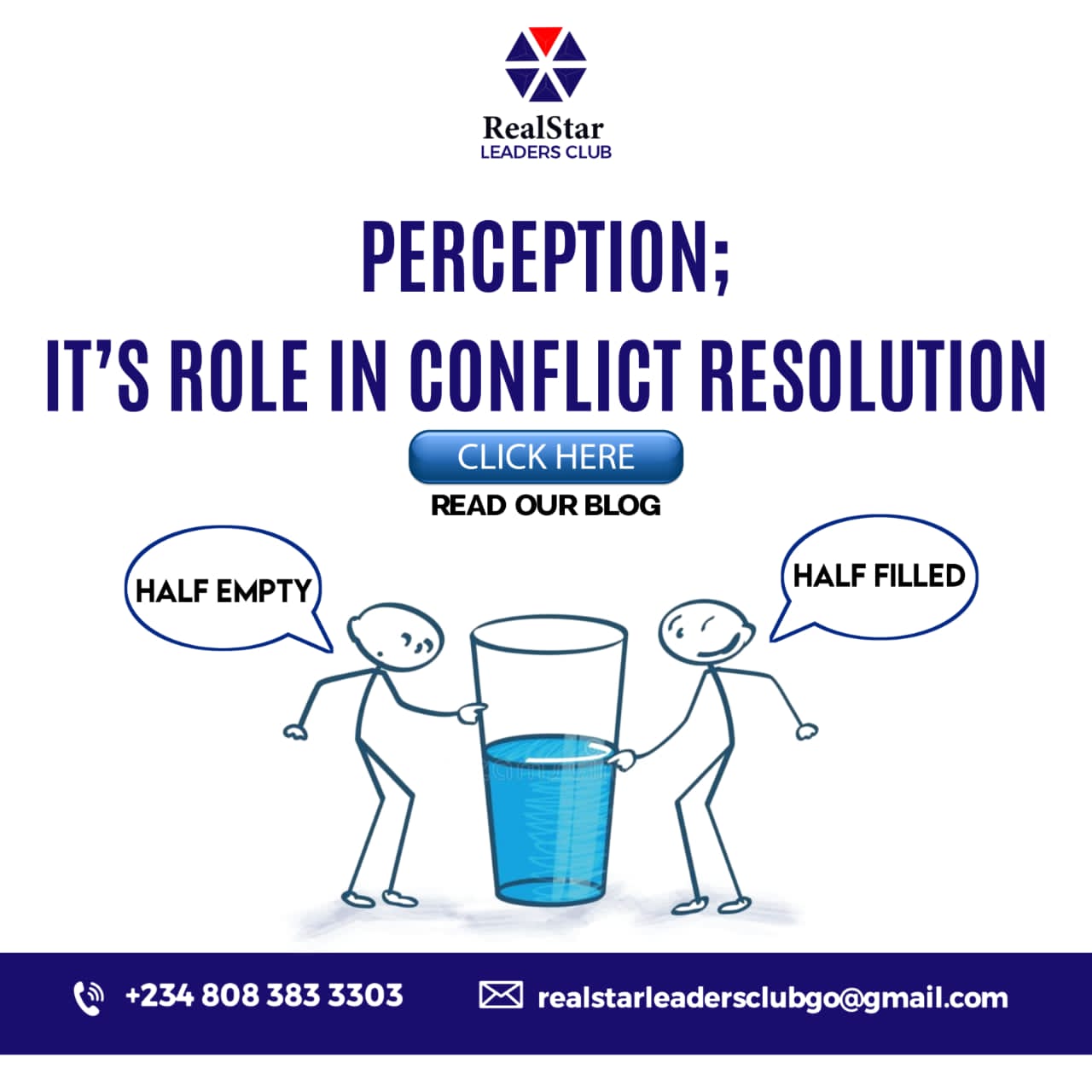
The half-filled or half-empty tale is an argument that although old can never be completely answered.
Why? The perfect answer is difficult to arrive at because “Two people can look at the same glass and see something completely different”.
You see, in every conflict, there are always two sides to the story or even more!
These different sides at times do not mean that one is correct and one is wrong. It mostly just means that the parties involved are looking at the reason for the argument from a different viewpoint.
This is where PERCEPTION comes in. Perception is dictionary interpreted as “a way of regarding, understanding or interpreting something” that is essentially unique to each person. Although, in some cases, individuals may share a common perception of an occurrence, however, there will always be some subtle distinctions.
Conflict on the other hand is not a unique phenomenon. It can occur in any formal or informal social setting wherever human beings are present.
Due to the fact that our cultural and religious background is a major factor in shaping our filters or frames through which we see the world, we must understand that Conflict might be INEVITABLE.
However, in Harper Lee’s words, “You can never fully understand a person until you consider things from their point of view”
This just goes to say that, you must not neglect the place of understanding the next person’s perception of things in any conflict.
Joseph Ravick, a mediator, trainer, and facilitator, talks about “not letting the APEs get you”. Here, he tried to emphasize the roles of ASSUMPTION, PERCEPTION, AND EXPECTATIONS.
One must be open to understanding how others have perceived the conflict and adjusting our perception when new information is received is key to managing conflict with others.
So, dear friends, we must be slow to anger in every conflict, watch our language and understand that there are other perceptions of things aside from yours.
But most importantly, a half-filled glass can also be a half-empty glass!